Biologics · Training guide
Viral Safety Studio
Write the adventitious agents safety evaluation (3.2.A.2): viral clearance totalled per model virus by ICH Q5A(R2) rules and the retrovirus safety margin calculated from particles, titre, yield and dose.
Open the tool at https://app.cmcfy.com/app/viral-safety.html. This guide is also online at https://cmcfy.com/guides/viral-safety.html
1. What this module does
The module writes 3.2.A.2 from three things: testing of cell banks, end-of-production cells and unprocessed bulk; viral clearance studies by step and model virus; and the controls on raw materials of biological origin.
It totals the log reduction values per virus, counting only one step per mechanism as ICH Q5A(R2) expects, then calculates how many retrovirus-like particles enter per dose and the safety margin after clearance.
What you get
- A Word or PDF file for 3.2.A.2 Adventitious agents safety evaluation.
- A summary file for the QOS Composer & Dossier Assembler.
2. Before you start
Have these ready. You can still start with the example data and replace it piece by piece.
- Production cell line, maximum single dose, production titre and downstream yield.
- Retrovirus-like particles in unprocessed bulk (TEM), for rodent cell lines.
- Clearance results (log reduction value) per step for each model virus, the mechanism and the worst-case conditions tested.
- Adventitious agent test results for the MCB, WCB, end-of-production cells and unprocessed bulk.
- Raw materials of animal or human origin with source, country and controls.
3. Step by step with the example
Open the tool at app.cmcfy.com/app/viral-safety.html. The example is loaded when the page opens, so every panel already has realistic data. Follow the steps to see how it works, then replace the example with your own data.
Enter the product and cell substrate
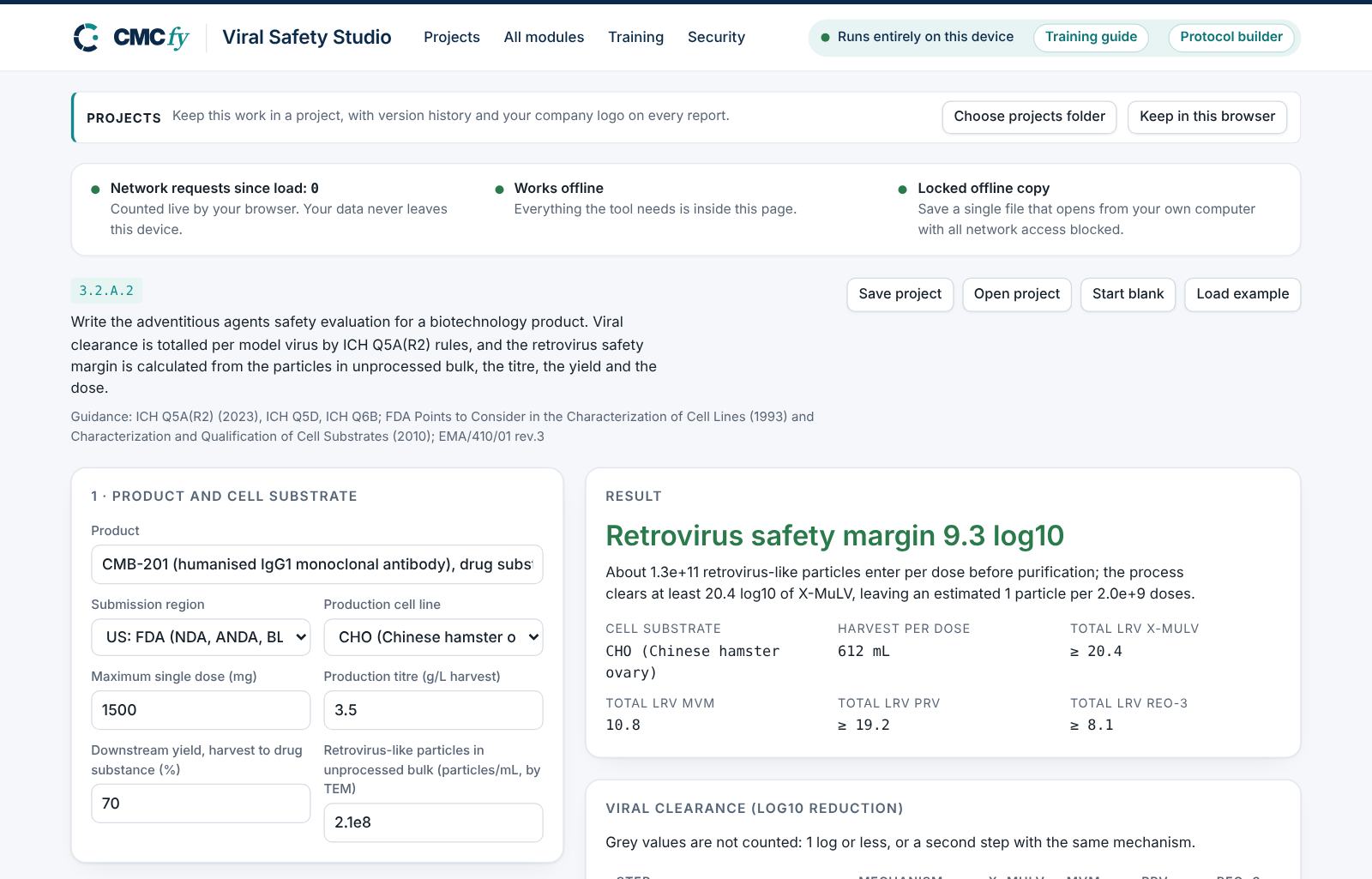
Choose the production cell line and enter dose, titre, yield and particles per mL. The example (CHO, 1500 mg dose, 3.5 g/L, 70% yield) needs 612 mL of harvest per dose.
Enter clearance studies
One row per step with its mechanism and the LRV for X-MuLV, MVM, PRV and Reo-3. Write "≥ 5.2" when no virus was detected, and leave blank or "n.t." when not tested.
Read the clearance totals and margin
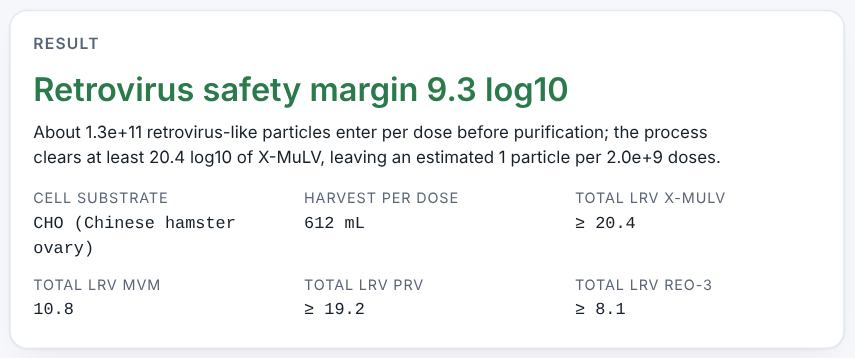
The headline gives the retrovirus safety margin: 9.3 log10. About 1.3e+11 particles enter per dose before purification; the process clears at least 20.4 log10 of X-MuLV, leaving about 1 particle per 2.0e+9 doses.
Check the testing table
Tests are grouped by material. Any positive result is critical.
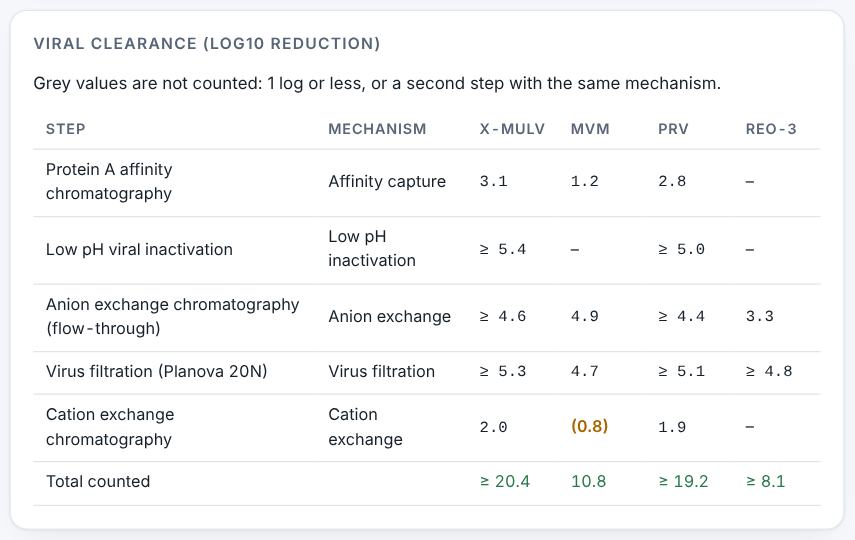
Viral clearance by step and model virus. Resolve alerts
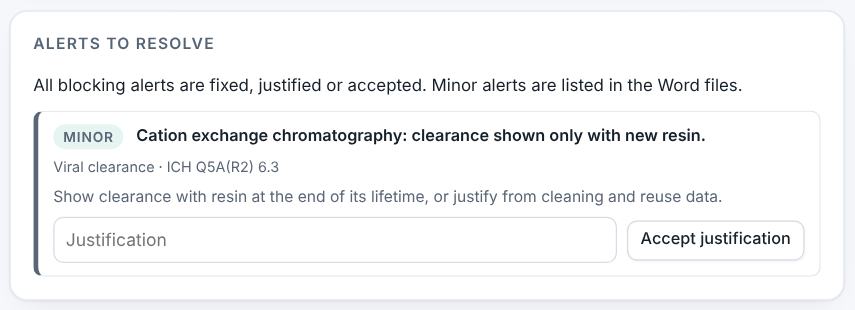
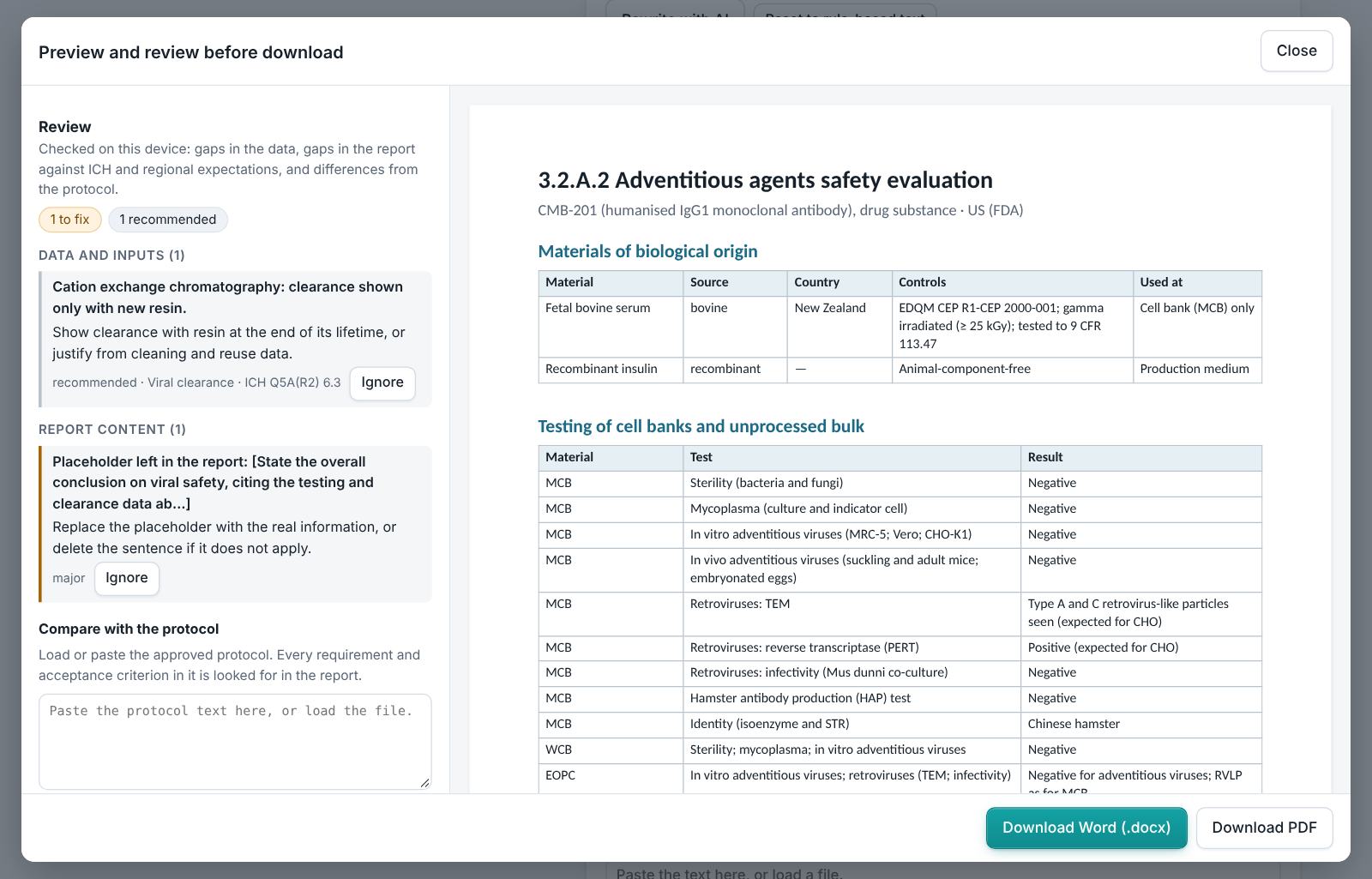
The example has a minor alert: ion exchange clearance was shown only with new resin. Add end-of-lifetime data or justify.
Preview and download
Preview 3.2.A.2, read the review and download.
4. Field reference
Every input in the tool, panel by panel. Tables accept rows pasted straight from Excel, comma-separated text, or a loaded file; check the columns after loading a file. Fields marked “when it applies” appear only for the choices that need them.
1 · Product and cell substrate
| Field | What to enter |
|---|---|
| Product | Type it in. |
| Submission region | Choose one: US: FDA (NDA, ANDA, BLA, IND); EU: EMA and national agencies (MAA); Both US and EU. |
| Production cell line | Choose one: CHO (Chinese hamster ovary); NS0 (murine myeloma); Sp2/0 (murine hybridoma); Other murine hybridoma; HEK293 (human); PER.C6 or other human line; Insect (Sf9, High Five); E. coli; Yeast (Pichia, Saccharomyces). |
| Maximum single dose (mg) | Type a number. |
| Production titre (g/L harvest) | Type a number. |
| Downstream yield, harvest to drug substance (%) | Type a number. |
| Retrovirus-like particles in unprocessed bulk (particles/mL, by TEM) when it applies | Shown for rodent cell lines; from transmission electron microscopy of unprocessed bulk. Type a number. |
2 · Viral clearance studies shown when it applies
Log10 reduction values (LRV) per step and model virus. Write "≥ 5.2" when no virus was detected, and leave blank or "n.t." when not tested.
| Field | What to enter |
|---|---|
| Clearance results | Use "≥" for no virus detected; blank or "n.t." when not tested. A table. Columns: Step | Mechanism (inactivation / removal) | X-MuLV | MVM | PRV | Reo-3 | Conditions tested (worst case, resin age). Paste rows from Excel, type comma-separated rows, or press Load file (Excel, CSV, Word, PDF or a scan). |
3 · Adventitious agent testing
Tests on the cell banks, end-of-production cells and each lot of unprocessed bulk.
| Field | What to enter |
|---|---|
| Tests and results | A table. Columns: Material (MCB / WCB / EOPC / unprocessed bulk) | Test | Result. Paste rows from Excel, type comma-separated rows, or press Load file (Excel, CSV, Word, PDF or a scan). |
| Next-generation sequencing used in place of in vivo tests | Tick the box if it applies. |
4 · Materials of biological origin
| Field | What to enter |
|---|---|
| Raw materials of animal or human origin | A table. Columns: Material | Source (bovine / porcine / human / recombinant / plant) | Country of origin | Controls (CEP, irradiation, testing) | Used at (cell bank / culture / purification). Paste rows from Excel, type comma-separated rows, or press Load file (Excel, CSV, Word, PDF or a scan). |
5. Checks and alerts
Calculations and pass/fail outcomes always come from fixed rules, never from AI. The tool checks:
- MCB tested for sterility, mycoplasma, in vitro and in vivo adventitious viruses, retroviruses and identity; species-specific tests for rodent lines; end-of-production cells and WCB tested.
- Unprocessed bulk tested for mycoplasma and adventitious viruses; any positive result is critical.
- Clearance studies include X-MuLV and a small non-enveloped virus (MVM), a panel of more than two viruses, an effective inactivation step and an effective removal step, ideally a virus filter; worst-case conditions and resin age stated.
- Steps with the same mechanism are not added twice to the total.
- Retrovirus safety margin: particles, dose, titre and yield given; X-MuLV clearance above the particle load (critical if not), and at least a 6 log10 margin.
- Raw materials of animal or human origin have TSE and viral safety controls.
How to resolve alerts
- Critical alerts block the download and must be fixed in the data. A failing result can instead be linked to an investigation: type the investigation reference and outcome and press Record.
- Major alerts block the download until you fix them or type a justification and press Accept justification.
- Minor alerts do not block anything. They are listed in the documents so the reviewer sees them.
- Some alerts have an Apply fix button that makes the change for you. Reopen undoes a justification.
Narratives
This module writes: Viral safety evaluation and conclusion. Each narrative is written by fixed rules from your data. You can edit it in the box. Rewrite with AI (where your plan includes AI) rewrites it in regulatory style; every number in the text is checked against your data, and a number that does not match is flagged under the box and blocks the download until you correct it. Reset to rule-based text brings back the original.
6. Preview, gap review and download
- Press Preview next to a section, or Preview and download all. The document opens in a preview window, exactly as the Word file will read.
- The left side lists the review, run on your device: gaps in the data (missing values, open alerts), gaps in the report (missing content the guidance expects, placeholders such as [site] or TBD left in the text) and, if you load the approved protocol under Compare with the protocol, differences from the protocol (requirements, criteria, batches or time points it plans that the report does not show).
- Click a finding to jump to the place in the preview. Fix it in the tool, then preview again.
- Optional AI review: a second read for contradictions, claims without data and vague wording. The report text is sent to Claude only when you press it, and only where your plan includes AI. Check every AI finding; AI can be wrong.
- Press Download Word (.docx) or Download PDF. With several documents open, All as Word (.zip) and All as PDF (.zip) download the set. The download buttons stay disabled while a blocking alert is open; the preview still works.
Documents this module produces
| Section | Document |
|---|---|
| 3.2.A.2 | Adventitious agents safety evaluation |
Use Save project to keep your work as a file on your computer, and Open project to continue later. Start blank clears every field; Load example brings the example back. Nothing is stored on CMCfy servers.
7. US and EU submissions
ICH Q5A(R2) applies in both regions. US mode cites FDA guidance and 9 CFR 113.47 for bovine materials; EU mode cites the EMA note for guidance on virus validation studies, Ph. Eur. 5.2.8 (TSE) and EU requirements for bovine serum. Next-generation sequencing in place of in vivo tests is accepted under Q5A(R2) when justified.
8. Working with other modules
- Cell banks and raw materials are also listed in the Biologics Process Writer; keep them the same.
- Segregation before and after viral clearance belongs in the Facilities & Equipment Writer module.
9. Common pitfalls
- Adding two chromatography steps with the same mechanism to the total.
- Using a clearance value from new resin only, when the resin is reused for many cycles.
- Forgetting the yield, which changes the particles per dose.
- Writing "0" instead of "n.t." for a virus that was not tested.
10. Practice exercises
Each exercise starts from the example (press Load example to reset). We run these on every update of this guide, so the result you see should match.
Raise the particle load
Change Retrovirus-like particles in unprocessed bulk to 2.1e12.
Expected resultA major alert says the safety margin is below the 6 log10 target.
Remove the clearance studies
Clear the Clearance results table.
Expected resultA major alert says no viral clearance studies are entered.